
What Is Glass Fiber Reinforced Cement and How It Improves Building Performance
Glass Fiber Reinforced Cement (GRC), also widely known as GFRC in North America, has become a significant material in contemporary architectural engineering. As building envelopes must now satisfy stricter requirements—ranging from durability and fire resistance to thermal performance and environmental resilience—designers and contractors increasingly rely on composite cement-based materials to achieve long-term reliability. GRC plays a central role in this transition due to its lightweight characteristics, high tensile strength, and exceptional design versatility.
This article provides a detailed explanation of what GRC is, how it is made, and how it enhances the performance of modern buildings. It also examines market demand, critical quality factors, common industry challenges, application scenarios, and emerging development trends.
The construction industry has undergone significant transformation over the last two decades. Urban density, energy efficiency requirements, and the need to accelerate construction timelines have increased the demand for materials that are lighter, more resilient, and suitable for prefabrication.
Traditional concrete, despite its strength, imposes limitations in weight, formability, and maintenance. At the same time, alternative materials such as metals and natural stones can be expensive or complex to install in large façades. This has created a strong market shift toward engineered composites that combine strength with reduced mass.
GRC has become a leading solution in this context. Its thin-wall structure reduces panel weight by more than half compared with conventional precast concrete, making it ideal for high-rise façades, modular cladding, soffit systems, and non-load-bearing architectural elements. The growing adoption of off-site manufacturing in Europe and North America has further strengthened the demand for GRC components.
Glass Fiber Reinforced Cement is a composite formed by bonding fine aggregates, cement, water, admixtures, and alkali-resistant (AR) glass fibers. These fibers contain a high zirconia content—typically above 16%—which provides outstanding stability in the alkaline cement matrix.
GRC’s performance relies on two fundamental material principles:
The AR glass fibers act as continuous reinforcement throughout the matrix. Instead of relying on steel bars or meshes, GRC gains tensile strength and toughness from fibers dispersed throughout the mixture. This enhances crack control and prevents brittle failure.
Because the fibers improve tensile behavior, GRC elements can be cast with thicknesses as low as 10–20 mm. This thin-wall design significantly reduces weight while maintaining structural integrity, enabling the construction of large-format façade panels with minimal load on supporting structures.
Together, these principles allow GRC to deliver a high strength-to-weight ratio that traditional cement-based materials cannot achieve.
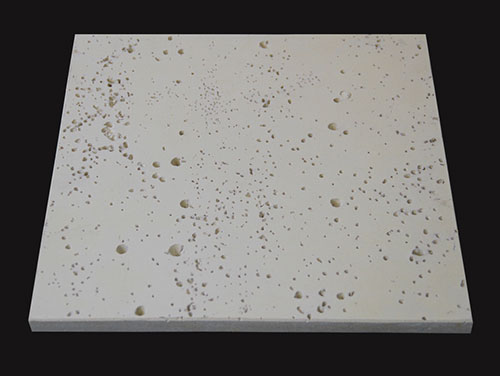
A standard GRC formulation includes:
Portland cement
Fine silica sand
AR glass fibers (either chopped strands or rovings)
Water
Plasticizers or superplasticizers
Polymer modifiers to enhance early strength and flexibility
Optional pozzolanic materials such as metakaolin or silica fume
GRC offers several performance advantages:
High tensile and flexural strength
Improved impact resistance compared to unreinforced cement
Low permeability due to refined pore structure
Resistance to corrosion and long-term degradation
Versatility in forming complex geometries
Two main production methods dominate the GRC industry:
A simultaneous spray of mortar and continuous fibers is applied into molds.
Advantages:
High and uniform fiber loading
Superior mechanical performance
Suitable for large façade panels
Chopped fibers are mixed directly into the mortar before casting.
Advantages:
Stable mix consistency
Ideal for smaller, repetitively molded components
Lower production complexity
Proper curing is essential for achieving the required mechanical properties. Controlled humidity and temperature curing environments help maintain dimensional accuracy and minimize early-stage cracking. Surface finishing—from exposed aggregate textures to smooth architectural coatings—depends on design requirements.
The mechanical behavior of GRC is highly sensitive to fiber quality and distribution. Insufficient fiber dispersion weakens tensile strength and reduces durability.
A well-designed mix controls shrinkage, improves density, and ensures long-term stability. Excess water weakens the material and increases porosity.
Dimensional tolerance, surface quality, and structural consistency rely heavily on mold precision and production discipline.
Inadequate curing leads to surface cracking, warping, or reduced long-term strength.
Projects located in coastal, high-temperature, or freeze–thaw climates must adopt appropriate sealing methods and anchoring systems to ensure service life.
Understanding these factors is essential for ensuring the performance of GRC panels on large building façades.
Choosing a competent GRC supplier is a decisive factor in achieving stable quality across an entire project. B2B decision-makers typically evaluate suppliers based on:
Proven experience in mid- to large-scale façade manufacturing
In-house mold-making and CNC machining capabilities
Ability to maintain consistent curing conditions
Testing protocols for mechanical performance and fiber content
Engineering support for anchoring design and system integration
Reliability in logistics and delivery scheduling
A robust supply chain reduces delays, minimizes installation risks, and ensures uniformity across multiple production batches.
Despite its advantages, GRC manufacturing and installation face several recurring issues:
Often caused by inadequate curing, inconsistent fiber distribution, or poorly controlled mix design.
Natural cement materials can vary slightly between batches, requiring strict pigment and curing control.
Lightweight panels require precise anchoring systems to avoid thermal expansion issues and long-term deformation.
Inaccurate or worn molds lead to dimensional deviations that affect façade alignment.
Poorly sealed or unprotected surfaces may absorb water, especially in cold climates.
These challenges emphasize the need for experienced engineering teams and high-quality manufacturing practices.
GRC is widely used across a variety of building types and architectural functions:
The most common application is cladding panels for office towers, hotels, cultural venues, and residential buildings. GRC’s lightweight structure reduces load on the building frame and allows for large-format or sculpted surfaces.
Thanks to its moldability, GRC is used to replicate traditional stonework, create custom patterns, produce perforated screens, and achieve complex three-dimensional forms.
Transit stations, bridges, tunnels, and civic buildings frequently adopt GRC for its resilience and low maintenance needs.
GRC aligns well with unitized façade modules and factory-built construction methods, offering repeatable quality and efficient installation.
The future of GRC is shaped by technological integration, sustainability, and advanced manufacturing:
CNC-milled molds, 3D modeling, and robotic spraying improve precision and reduce material waste.
Developers increasingly incorporate supplementary cementitious materials to lower carbon emissions and increase durability.
GRC combined with insulation layers, lightweight frames, or high-performance coatings supports higher building envelope standards.
Research continues on improving the fire endurance of composite GRC panels for stricter code compliance.
As modular construction expands, GRC is becoming a preferred cladding material due to its predictability and lightweight properties.
These advancements position GRC as a long-term contributor to high-performance and sustainable architecture.
1. How long do GRC panels typically last?
Depending on environmental conditions and quality control, GRC panels can remain serviceable for 30–50 years or longer.
2. Is GRC suitable for coastal climates?
Yes. AR glass fibers do not corrode, making GRC suitable for marine environments where salt exposure is a concern.
3. What thickness is commonly used for façade panels?
Most façade-grade GRC panels range from 10–20 mm, balancing weight reduction with necessary strength.
4. Can GRC support structural loads?
GRC is primarily used for non-load-bearing components, but hybrid systems may incorporate additional reinforcement for specific applications.
5. Does GRC require special maintenance?
Routine inspection and periodic sealing can extend service life, especially in harsh weather conditions.
Glass Fiber Reinforced Cement provides a combination of material efficiency, design flexibility, and structural performance that traditional cement products cannot match. By reducing weight, improving durability, and supporting advanced façade geometries, GRC contributes significantly to modern building performance. As digital manufacturing, sustainable materials, and modular construction continue to advance, GRC is positioned to remain an essential component of innovative architectural design and high-performance building envelopes.
କୁକି ପ୍ରୋଟୋକଲ୍

 English
 Español
 Portugues
 Pусский
 Français
 Deutsch
 日本語
日本語 한국어
한국어 العربية
 Italiano
 Polski
 Türk dili
 Melayu
 中文
中文 қазақ
қазақ עִברִית
 українська
 norsk
norsk o'zbek



 ଫୋନ୍
ଫୋନ୍
ମନ୍ତବ୍ୟ
(0)